
Podcast 3 | Ben chats with Nemani Nadolo, one of the world’s best rugby union wingers in the last twenty years.
NEMANI NADOLO
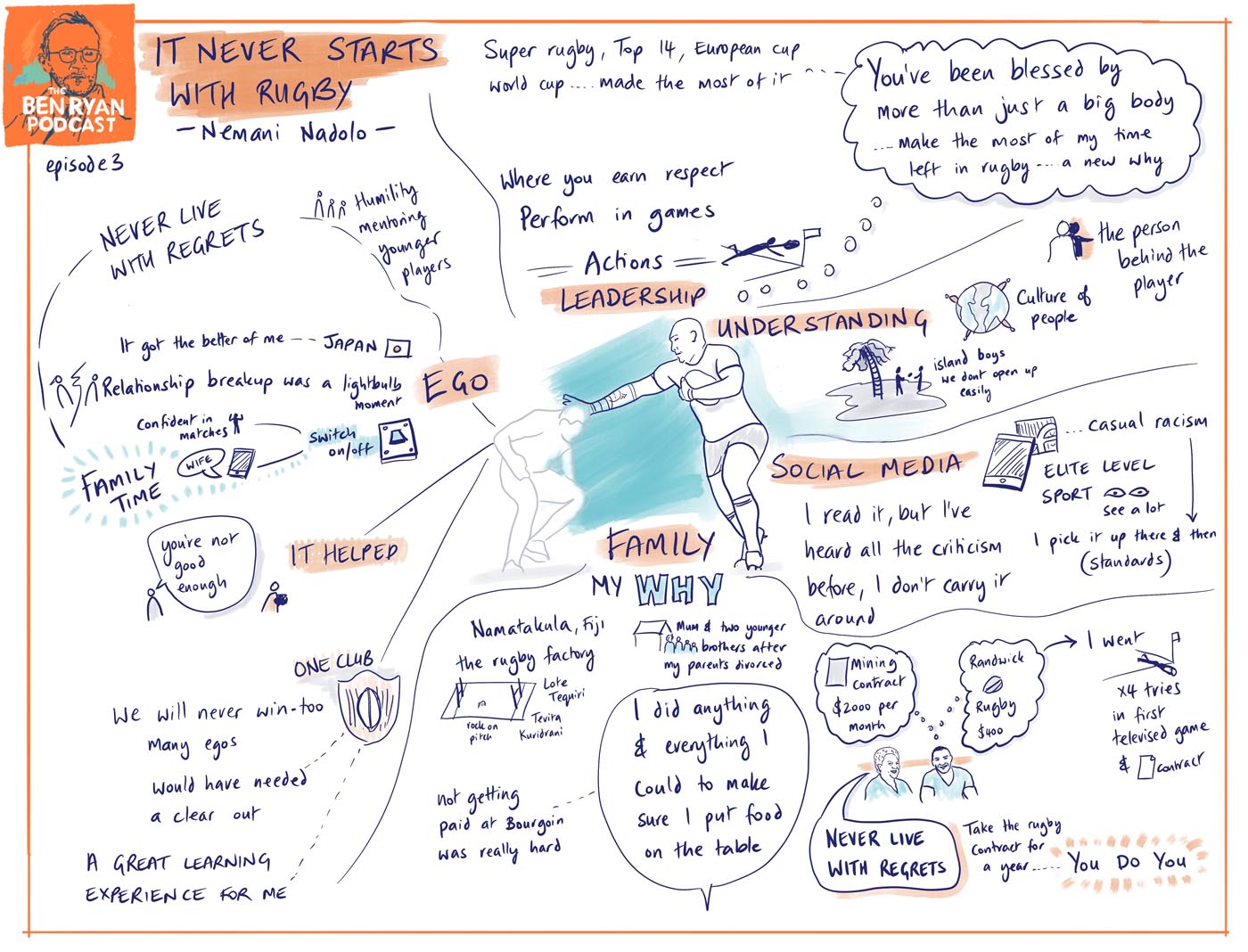
About this episode
‘my why was putting food on the table’
From his beginnings in Sigatoka ‘Rugby Town’ in Fiji to gracing every top professional league in the world, rugby superstar, Nemani Nadolo’s story is an engaging one.
One of the world’s best rugby union wingers in the last twenty years, it’s not been a straight path to his many achievements and honours. Indeed, at one stage it looked like Nemani might not have a career in rugby at all, but thoughts of lucrative work in the mining industry soon turned to following his passion and eventually lighting it up at a Rugby World Cup. It’s a story full of takeaways and cognisance.
I met Nemani, pre covid, in a park in Oadby, Leicestershire, shortly after he had signed to play for the Leicester Tigers in the Gallagher Premiership. As the lawn mowers buzzed in the background, we spoke about the importance of understanding the individual, controlling your ego and a whole lot more. This became an emotional chat and I thank Nemani for opening up to me.
It was also a conversation I wanted to have early in The BenRyan Podcast as he was one of the first people I reached out for advice when I began my time in Fiji.
Just chatting to Nemz in a place thousands of miles away from the south pacific, instantly reminded me of the warmth of the Fijian people and the importance of family and relationships.
To get the best out of anyone, first, you listen and then you learn.
Here we go…
Nemani Nadolo is a Fijian-Australian rugby union player, usually on the wing or at centre. His full name is Ratu Nemani Drui Siganiyavi Nasiganiyavi Nadolo. Nemani gained 5 caps for Australia U20s and 30 caps for Fiji.
Nemani has played for teams in Japan, Super Rugby, and Top 14, and currently plays for Leicester Tigers in Premiership Rugby.
Youtube channel: The Nadolos
Connect with Nemani:
- Nemani Nadolo Highlight Reel – vimeo video
- Map showing location of Sigatoka and Namatakulu – google maps
- Leicester Tigers RFC – website
NEMANI NADOLO
For me, less is best around game day. In some teams that I’ve played in it was all the players, you do your own thing, and there wasn’t there wasn’t even a meeting, you just get on the bus, and you’re off to the game, because that was given the ownership to the players, you know, because, well, let’s say the team that, one of the teams that I was in, the coaches ran the show from Monday to Thursday. And then from Friday, there was no one on the field but the players, Friday lunch, and then Saturday.
And if it was an away game, it was all it was all the players, you know, and that I think was really good because it gave us the ownership, a bit of ownership, to be like, right, coaches have done their job so, you know, now it’s our turn.
It just depends on the team that you’re in, and the individuals that you’re playing with, if that makes sense.
And the one thing I’ve seen over here in the northern hemisphere of rugby, there’s a lot ownership, you know, amongst the coaches and stuff to take all that game day stuff and, you know, like prep the game right up until maybe kickoff. But, you know, it works here for northern hemisphere, Southern hemisphere, different, you know, it’s good, and it’s bad. But for me, personally, I believe the player should be professional enough to prepare himself for that game, because the end of the day, the work has been done. If you haven’t done the work during the week then you know, there’s a problem come game day.
Yeah, no, I get that. And we talked a little bit about how you like to be coached. And I guess it comes into like, the language that you have around you from the coaches. Like when I went to Fiji, Iso Damu who I was coaching in England, and he said a couple of things, like don’t swear to the boys in public and don’t have an argument with someone in public, you know, because that’s just not the way to be doing things.
Take someone to the side, have small conversations and stuff. And I kind of thought, that’s not a bad rule for life. Right? You don’t need to scream and shout and take strips out of people in front of everyone. But is that how you like to be managed?
For me, it’s just, just talking, like I said, like, pulling it aside. I’ve learned over the years, I just need to be told once like, I, I don’t like it when, when you when I’m getting repeated, you know, and I’m getting told so many times to do one thing. But if that happens, then I’m not doing my job.
So, I’m the sort of bloke that, you know, pull me aside. You know, I guess no one likes to be told off in front of everyone. But if it happens, it happens. But you know, I’d like to think that as a player, as a person, you know, you could pull me aside and be like, this is what I need from you, this is what I want from you. And then the rest is that, do yo know what I mean? And then I’ll go on and do my job.
I’ve been in situations, I guess, where as a player you’re getting told that you’re not doing certain standards or not behaving in certain way. And you know that that coach is not behaving in that way either?
Do you think it’s important that, I’m reading about Bourgoin, for example, in 2010, where you weren’t even get paid? That I’m sure whatever they were saying to you, and they weren’t holding up their side of the bargain, it’s gonna not maybe fall on deaf ears, but it doesn’t have that kind of, it’s not going to make you want to believe them and, I guess, follow them.
Yeah. 100%. And I think, as a coach it’s important. It starts with the coaches, I think, and I’ve always said this, if you’re gonna say one thing, and you do another, don’t expect your players like, you can’t be that person to be going off at your players. And I’ve had, I’ve had one in particular, won’t say a name, but where it was, like, say one thing, do one thing.
And you know, I’m just thankful that I was old enough, mature enough, as a rugby player just to get on with my job. But it’s hard for players to react that way if, you know, the boss isn’t doing his part of the agreement, or the organisation and, like you said, at Bourgoin, I didn’t get paid. I was meant to get paid 5,000 a month, Euro, which was a lot for a 21-year-old back then. And I rocked up, and they didn’t pay me from the first – I got paid 1000 euros, and they’ll kept saying, you know, excuses, excuses. But I was like their player that needed to, to perform.
And I was young then and they were like, you’re not scoring tries, you’re not doing this. And I was like, it was hard for me at the time as you’re not paying me. And so that was, that was really hard because I just moved over and I was you know supporting a family and, and all that stuff. So, for me, it’s hard for me to respect you as a person if you’re, if you’re telling me one thing, but doing something else.
And I think it’s important for coaches, you know, there’s a lot of good coaches and a lot of bad coaches. But if you got peace and clarity and you’d get on, like you do it, you do what you say you do.
And if there was, I guess, with all the different programmes you’ve been involved in, think of one or two things that you think is absolutely necessary for any sort of winning culture, any high-performaning team, is there anything that you go this is what we have to have?
Understanding your players, particularly guys have come from different cultures, especially with the way rugby is going. That right now, teams from Europe are signing guys from Argentina, Georgia, Samoa, Tonga, Fiji, South Africa. These countries all have different cultures, we all have different upbringings.
Now, I’m not saying you sit them down and, you know, but it will help to get to know that individual’s past, that individual’s family, the life, because the moment you get to realise you get to know them, and what they are off the field, I think it’s going to be easier for you to conduct. And I think Leicester [Leicester Tigers] have done that well with me. I know they’ve, you know, they’re looking after Thomas Lavinini, who’s Argentinian International. And it gives me like, I can only speak from my experience, but the way Leicester have dealt with me since I’ve got here with Steve Borthwick, you know, Aled, our trainer, and the medical staff. It’s just been like, it’s reignited my rugby career.
They took me aside, took the time to care about not only what they want from me as a rugby player, but what they want from me mentally, because mentally, it’s just as important as being physically fit in rugby, especially with now with social media, with people telling you this and that, you know, and every day I see those guys are like, how’s your family?
Now you do that to me, and I will, you know, I’ll take a bullet for you.
Yeah, I used to, I mean, I used to find, I’d get more out of finding out about someone just walking maybe from the sheds to the changing room, or sharing a boo underneath a coconut tree after training. But the western mentality often is one on one, sitting down, formal feedback, and all that sort of stuff. But you think actually, it’s those informal chats, that’s valuable for you to feel like someone actually is thinking about how you are?
100%. And for me, I don’t like formal chats and stuff. So, the informal stuff, especially with the thing I thought they did well, and one of the teams that I played in was, it wasn’t about you as a rugby player. It was you as a person. And I think what they did was when I spoke to one of the coach at the time, he was like, when we signed people, we don’t sign because of the way they play rugby, we sign their character, and we do our research on their character.
And I know, it sounds like, get on with it, it’s rugby, it’s tough. But if you care about the players, like, just feelings and just just talk to him, how are you? How’s your family? How’s this? How’s that? What can I do for you? Straight away, you’re gonna be like, hold on, this guy wants to be my friend, you know, and that’s hard for some of the Islander boys, don’t get me wrong. It’s hard for us to open up. Islander boys come from nothing. And so they won’t talk about anything. You know, we’ve had stories in France, where guys have committed, Fijian boys have committed suicide, because they didn’t talk up. And because the clubs didn’t help them or didn’t do this.
I’ve had, I’ve had calls from a French club that said, we got a player and he’s, he’s either got a drinking or gambling problem, because the banks rang up, and he’s gone over his overdraft again. I was like, mate, go to his flat, just have a look. They go to this flat, there’s nothing in his flat, and he’s sending all his money back home. And there’s no, there’s also no one to talk to. And he’s literally, you know, on the edge.
And that’s it mate, because we don’t get that education, you know, because we know, all we know, is to look after our family. And if clubs can realise that, yeah, and that’s where a lot of guys, Fijian boys go wrong in France. And I say that wholeheartedly. Fijians boys go wrong in France because they get treated as if you’re French, you got to learn the language. And you get on with it. And when payday comes, they’re not told, listen, this is what happens. This is what and so. You know, like I said, you’ve got to just learn your player where they come from. You can’t just be going get the world’s best player from Fiji and not know anything about him and just expect him okay, because he’s scored five tries, he’ll score for us.
Rugby now, or sports in general, there’s more into it than just playing sports, and just rocking up to training. Being mentally fit is just as important being physically fit.
I totally get how when everyone’s, when it’s younger, it’s tough right to stand up in, especially in a senior group, with lots of players. But do you think experience is what helps you kind of be able to do that now? And do you feel confident, like take Bourgoin when they weren’t paying you and, and you are 21-year-old coming into a foreign country and foreign language? Did you feel you can stand up and you can kind of ‘up manage’ those people? Or do you just have to get your head down?
Yeah, I mean, at that there and then no, probably not. I think, you know, it was like, Yeah, I was afraid I was scared to talk up because I am in a country where if they cut my contract, where do I go? What do I do you know, but like, you know, I wouldn’t like to for me I like to use a word mature, you know, as you mature over the years. You know, if it happened now, yes, I’d talk up and say something, and, you know, but it’s tough. Yeah. But as I said, Now, these days as days gone, you got younger kids, you got younger captains, you got younger leaders. But me personally, I probably wouldn’t have said anything. And I would have complained and stuff. But you know it would have just fell on deaf ears, I guess?
What sort of leader do you think you are now?
Good question. yeah, that’s a good question. What sort of leader I’d say, I’d like to think someone who, on the rugby field, you know, says go back to rugby, a leader that just does the action does, you know, leads by, by action, I guess? You know, I’ve, you know, I’ve always said to myself, man, it’d be good to captain a team one day be good. But if I look back the last two, three years, I’ve actually been a leader in my team, just without the captain, see, if that makes sense, you know, leading by, you know, just making sure that I perform, you know, during the week, and during the week and at training and in games in particular. And so, I’d like to think that, you know, I’m more of a action doer in terms of, of leadership. And I think that’s also where to where you get your, your respect, as well, you know, especially in the rugby fields in the Rugby World, where it can be tough to, you know, it’s hard to talk up when you’re younger, and try and be a leader because, I mean, it’s changing now, but back then, when I first started a lot of older guys from the old era that was finishing up and just be like, you know, your place? shoosh So, yeah, like, to think I’d lead by action on the field. And, you know, that hasn’t changed. It just gets harder as you get older as you get older. But no, it’s good.
And I guess we talked about experience, so when you know, you started out at Nudgee and then when that Queensland schoolboy side yeah, Will Genia was in that team, Pocock?
There are a lot of Wallabies…
Maybe even Kurtley.
No, he’s New South Wales…that year Australian schoolboys are a lot of them. But a lot of them came out of Queensland. Yeah, they all went on to, to represent Australia.
I guess thinking having that in your head about starting there and being now where you are now. And if we were kind of talking about ego, and ego is this fine balance in sport, where you’ve got to have a bit of an ego if you’re gonna walk out in front of 50,000 people and do your thing 100% but then you’ve also got to have that humility, I guess. And I’ve seen it in elite sport where egos can get people into a lot of trouble especially as coaches because they can you know; they can be really stubborn in what they’re doing because they don’t want to back down. Have you had any like any dramas with your ego where you’ve had to battle it a bit over your career? And do you feel like your ego your ego is a good mate now?
I won’t lie to you when I was in Japan. I think my ego probably got the better of me. I was 22 then 22 or 23.
Green rockets?
Yeah, the Green Rockets at NEC? like yeah, I would say ego got the better me I thought, you know, I I’d you know, planning Japan, you know, scoring tries left, right and centre without being arrogant or anything but tries came easy. Yeah, back then for me, and then. And I, my ego probably got the better of me off the field as well. And my wife will be the first to tell you that. And so, you know, I’ve my wife’s a bit older than me. But she was a bit more mature. But she I’m just thankful that she you know, she understood that I was young, but same time my ego. was like, I’m better than this. I’m better than that. You know, and I was playing in Japan and then I think it that all changed once me my partner broke up. And I realised okay, got do something about this. I was in and then that’s when I went to New Zealand then we broke up, so I let playing the Crusaders get a bit, get a get to me. You know, I thought I was something that I was actually not. And you know, I’ll be the first to admit it. And it’s Yeah, that’s ego right there. And I think once me and my wife now my partner at the time we broke up it was like that all that a lot of that changed
That lightbulb moment?
Yeah, like a lava lamp, you know, you know the one person that you really that really there for you is not there and so, you know, I owe a lot to her. You know, fast forward to now. My ego is within myself now. So, I haven’t I haven’t inside I’ve got this ego, where I think I’m better than you. But I’ll never tell you I’ll never show you. But outside it’s that comes with maturity, you know, you learn to control this ego like and now it’s my friend. So, when I go to training, right now, I’ve got a lot of young guys who are pushing for spots, you know, and I’m this signing this big name signing that came over I don’t that’s what it’s been said. But like now that egos now that is my friend I can be like, right. You know, within myself I’m arrogant. If that makes sense. Inside I’m and part of that has it’s always been inside me, but it’s just gotten stronger as I get older.
Yeah. So, I would talk about wanting to talk about the Fijian sevens team too much but when I remember going into before the Olympic final where I didn’t have to say anything and had this speech and I there was no need because I looked at the boys and they had that very unique I guess you’re lucky as a coach, you get a team that over competent. Yeah. So like you know that they’re bombproof in their decision making their skills they’re fit they’re aligned. But then when you’re working with teams like that, sometimes you get overconfidence because like you know, like Well yeah, get the ball and I’m going to score is like you know, this is too easy. And I suppose you’re kind of talking a little bit like that that you’re you’re over competency is there but you’re not allowed in that overconfidence but inside you know that you’re better than that your opposite man and that’s what you’re going to show but you don’t need to scream it from the rooftops is that kind of what you’re saying?
100% I think you’ve nailed it on the head there with screaming from the rooftops you know, and like I said, it always goes back to being action in terms of being a leader and showing how my leadership is but that comes back to being confidence within inside myself. Now I’m a bit older, I’ve got a few niggly injuries and you know, the body moves on but inside that spark of being that arrogant ego is not only is not now my enemy is my friend. So, you know, I know when it’s turned on and I know when to turn it off and now with my son in the world it gets turned off really quickly. Because you know, I get home and then I’m the dad so…
Have you got any good triggers anything that you use? Or you’re more aware now I say yeah, cuz like we all have those days, like long days you’re getting agitated or things aren’t quite working out and your ego is, you know, popping out a little bit more. Are you more aware? Can you park it now? Can you push it back?
Yeah, 100% I think once I leave the rugby field or the rugby HQ, it just turns off, it’s bonkers. What I do now is I’ve made a made a, I started this in France, when I leave rugby, I call my wife straightaway. And that’s kind of like the switch to be turned off to me. And then it’s I know, it sounds it doesn’t sound as much but it does a lot for me because it’s, you know, I can the moment I hear my wife’s voice, it’s like, alright, it’s home life now. And so now with baby now, you know, I’m straight in the car. And I could still be tense from that training. Like I might have dropped the ball, I might have missed the tackle. And I’d be hating myself, you know, so the drive is still there. But as soon as I get in the car, it’s like right, turn on. And then at least it gives me a few hours now to bring the ego down. And then at night I do some homework, I review the training and you know, do all the stretching and the recovery stuff and then it does come out a bit you know, I mean, but then I always I’ve got things in place now that that can control that. Yeah, and it’s funny because you don’t think about it when you’re doing it but when we’re talking about it like oh yeah, that is actually what ego is you know yeah. And then so I have things in place that turns it on turns it off.
Look when I first started this when I first got told I wasn’t good enough at all It always I always start back from there. My ego was jumping out Yeah,
I’m not I’m better than you know, I think I’m good enough to do it. So that there’s been times where I could control it and though there was one time where I couldn’t control it now is my ego controlled. I’d like to think so. Will it ever get the better of me Who am I? Right now, my in my career no. in my life? No, I think I’d like to think that I’ve done everything I can I have done it as a professional rugby player, you know, played around the world. I’ve done everything. I’ve got a I’ve got a small family now. And that that now has kind of put the is kind of putting the light out on that ego. You know now, like I said, it’s amazing how when you, you know, I’ve been fortunate to play eleven years as a professional. And I’m at this part of my career where I appreciate a lot of the things now, you know, you know, and I’m in a position now to help young guys. So ego, you can’t have an ego for that, you know, you’ve got to be opening and willing to help these guys. I mean, when I was younger, and I had older players who I looked up to, and they were there, I kind of didn’t get that it was kind of like, Don’t do that. Don’t you know? Whereas I wouldn’t tell a young guy don’t drink i would i would tell him you know, listen, make the right choices, you know, and so you can’t have ego for that. And I think I’d like to think my egos slowly coming down and wearing out because the only time I get an ego is when I have an argument with my wife and you know, more times I just, from right or wrong, she wins. That’s the only time the ego gets a bit hot
Cuz, you know, I mentor to a centre forward that plays professional football. Yeah. He finds it hard not to look at social media after game. Like, if he’s, if he’s done well, or he’s done badly. Yeah, he looks at it. And if he’s done badly, that following week training his heads down, he’s wants to get in and out training as quick as possible. Yeah. Sounds like you’re kind of, you’ve got a good measure on that. Now, like you’ve in a positive way, if you understand how much some of that stuff is just comes with the job. And it’s, it’s not about you, it’s probably more about them, what about with the other guys coming up now? Either that or have already are there or coming up the track? Do you see any big egos that you’ve struggled to deal with? Or had problem as a teammate or that you’ve helped and kind of steered them?
I wouldn’t say there is egos with these young guys coming up. Or not that the guys that I’m playing with?
I mean, I guess in your in your career really is there’s ever been? You’ve been in a culture where there’s someone’s ego that’s just been hard to contain, you know, not naming names?
How do you have you seen any decent solutions to, you know, that, that it’s not necessarily a maverick, but somebody that’s the egos almost getting in the way of achieving that?
100% Yes, one club that I was at the, the ego was so bad, that you just knew you weren’t gonna win a Premiership, you just knew and the only thing we had in common was, we could all play rugby. And so, and it’s just hard, because you can’t, you couldn’t change it. And that, for me was tough, because we had a, you know, I’d like to think we had a good chance of doing really well. And, you know, a few egos there that probably would have made it hard for us to do well, but you just get on with it
Did anybody would have been able to change that would have made it put any sort of looking back at it. Now, any sort of guardrails in place, or any feedback on it?
It either had to be cleaned out, or it just couldn’t be changed within that group. And so, you know, as much as it was a negative, you know, it was a learning curve for me, because it was like, well, this is what I don’t, you know, you learn from those sorts of stuff. And you could take it either, you know, one or two ways you can hate it and hate that, or you could learn from it. And I always like to think that out from every country that I’ve been in every competition I’ve played in; I’d like to learn from what went wrong what went right. And, you know, you’ve got to take the good with the bad, you know, you’ve got to take the criticism, you know, with the compliments, and I’ve had a lot of my career. And so, like you said, You talked about that player that, you know, can’t help but read social media. Like for me, I’ll read it, but does it get to me? Yeah, it does. But do I carry on with it? No, because I see this, if if I’m out there doing it, you know, putting writing on Twitter, or writing on Instagram, whatever. And whether it’s good or bad, then I should be able to take if someone writes bad about me. And at the end of the day, it’s just words, you know, I mean, some words are harsh, you got to pick up on, but I’ve heard it all before in my career, you’re not good enough. You’re too slow. Why did you drop the ball? But, you know, sometimes part of it was my fault. And you’re like, yeah, fair enough. But then other times you’re just like…
Oh, yeah, would you ever pick anyone I guess let’s jump into one of my other big things that principles is the standard you walk past Yes, the standard that you become so I use the example that like I might be starting at six in the morning for a long Training Day, not finished till 10 I see one of the players being rude to a cleaner and I’m thinking that I deal with it in the morning because I saw what he did and I’m tired. I want to go and grab some food. And if if I leave it then I’m that person being rude to the cleaner and I saw you recently like you picked someone up on some casual racism on the stuff that often comes up about Fijian name pronunciations and things like that. And like how many have you always kind of stopped to kind of stop, you know, have you done you always feel that that’s something that you’ve always had the standard that you walk past is important, and you’ll always pick someone up on that.
You don’t know any better, you know, you’re 21 Yeah, you’re coming to the world. As you get older, and you know, as you’ve been exposed to a lot of these things, and don’t get me wrong, you know, being at the elite level, you know, it’s a luxury as well as a curse at sometimes, you know, because you do get exposed to some of this stuff, in particular racism, and, like, I’d like to be picked up if someone said this to me, or, you know, and I get it all the time. You know, you played rubbish, you played this either. But for me, I think it’s important, too, that if someone does something on the spot that doesn’t sit well by you pick it, you know, say something about it, you know, you might not change the person. But, you know, it needs to be said there. And then because then I always say like my little brother. I love him to bits he’s 21, he’s, you know, I’m looking after him at the moment, but I’m onto his back. Because it’s not because I’m that person is because I want him, it’s gonna make him a better person in the future. You know, I mean, and I think if you if you don’t do something right there, and then, in your mind, and in their mind, it’s gonna be Oh, that’s alright. You know, it’s okay, I’ll do it next time. But you know, you’ve really hurt someone there. So, no, I think it’s important for me as a person, and I think, in life in general,
Yeah. So, I got, I got given some good advice once where if you imagine this four people and one person doesn’t matter what you do, they love you, you know, your mom or your wife or, and doesn’t, you know, if you’re terrible, you’re great that they’re never gonna think you anything other than brilliant. Yeah. And then there’s another one at the end that it doesn’t matter what you do, either. They just don’t rate you. And you’re never gonna change their mind. But the two guys, or people in the middle, just say what they feel based upon how you are in the present. And I guess that that’s the stuff you try to realise if you need to improve, or you’re doing well.
100%. And for me, now, my career, if I, for me, it’s just listening to the coaches I used to, I used to take that in a bit, you know, he’s not this, he’s not good enough. He’s too old. But for me now, it’s like, I just listen to the coaches give feedback to them, they’re the most important feedback and my wife, and then, you know, I like to think Twitter now as a show as entertainment. You know, it’s just sometimes you’re in it, you’re part of the character, you know, and…
Do you care, you care what people think about you?
No. I honestly, I’ve been around that long that I’ve had, from the start of my career to now I’ve always been, I’ve always been written off, you know, I’ve always been told I’m big too slow. And that so, you know, it’s like a bad cough, really, and it, you know, it’s just gonna go away, it’s just, you can deal with it, and move on. So, but when they start getting personal, you know, when you start talking about things that I stand for, then, you know, I’m gonna say something. But then, again, you say something, there’s always got to be an opinion. Like I, you know, I said something about that casual racism, and then people are breaking it down and saying this and that and you’re just like, okay, but, you know,
i
She, you know, she, she’s a Leicester supporter, or he or she, is a Tigers supporter, so, you know, you’re supporting me at the end of the day. So, if you’re gonna make fun of, you know, of your players, it’s up to us. It’s up to us. And it is this education you got in England, they probably wouldn’t have heard of these Fiji names, and I can understand the English jokes. But you know, there’s got to be a point where like, listen, it’s not you know, it’s not acceptable.
Yeah. And you changed your you’ve changed your surname. Yeah, yeah. When I look on Wikipedia as well it says you’re born in Sigatoka. Now you weren’t. Well, you were born Robbins but you’re born in Nematakula right? So you were born in Sigatoka?
No people get mixed up I was born in Sigatoka and then moved over…
For those of you that don’t know Sigatoka is like rugby town in Fiji. They’re crazy about you know, they are crazy all over Fiji but in Sigatoka Yeah, but then Nematakula, which is a cool little village that you drive down there. I think it’s the Queen’s highway. Down on the way to the Nandi or Sigatoka and I took I took the Fijian sevens team there once because I kept driving past it and you know; you’ve got the pitch with the school. Yeah. And there’s like a, I don’t know, there’s a big rock in the middle of that.
Still there…it’s massive! It was there when I was a child.
Yeah. So, we took we took the boys out to play to play rugby against the village is a lot of fun. And a couple of the boys went on to to get into the Fiji team from there.
Nematakula we call it the rugby factory. Because it’s fun to come out from there. Oh, it’s back in the 90s you had Nandruku play for Canberra Raiders and then most recently had Lote Tuqiri who played obviously went on to be a dual International, myself my brother then now you got Tevita Kuradrani playing who’s playing for Wallabies and Brumbies. And then obviously got few guys playing sevens and it’s amazing that he’s still got league as well you got a few plays playing League, so we call it the rugby factory where? Yeah, I think if you Nematakula in Fiji A lot of people will direct you to the right place.
100% I guess it goes back to what I talked about with Div one of the seven players, probably the best 7s Tuwai player in the world, the moment Jerry Tuwai. So, when we went to when I went to New Town and, and I met his parents, and he lived in a settlement. And, you know, they talked about when he left school at 14 or 15. And he would dive for fish in Booth bay with his, his dad, sell the fish. And I was trying to get him to be more consistent because Jerry was great and great in games, but he didn’t want to train very hard. And then they talked about how you know, he wanted to be a rugby player. And that was his dream. And they saved up for a pair of rugby boots. Yeah. And they handed him his boots said, this is your knife. This is your fork. This is what you’re gonna put food on the table for us. And for me, it was really powerful about delivering why Jerry does what he does. Yeah. You must have a big ‘why’ from your from your background, right?
Yeah, it’s similar. My why is obviously, my family, my mom and dad split up. When I was just, I had another year high school, I was at Nudgee and I had another year and my father and my mother, divorced father remarried pretty quickly. And so, mom left my mother with a mortgage. And at the time, two younger brothers, and my older sister had gone. She was the eldest, so I was the eldest boy, second eldest and so I left high school. And I think that’s where it all started. Because for me, it was supporting my family, but back then my brother is now 20 and my other ones 27. Back then that was still in high school and primary school. So, my why was making sure that I had food on the table, and, you know, clothes on their back, and, you know, I did anything and everything to, to, to get to make sure that we’re fine. So, I mean, I, not many people know this, but I played in Malaysia for six months, just earning some money or played in lived in Malaysia, in Kuala Lumpur. Yeah, KL played for the corporate team. Yeah, and, you know, so and a bit of money living there. And then I came back and, you know, I did anything and everything to just to make sure that you know, that they had food on the table. So, the early part of my career, rugby wasn’t because I wanted, you know, I want it to be played the top it was to earn money so that I could send home. And then it wasn’t until I went to, I came back from Europe, my first stint in Europe, that I realized that I could actually, you know, be someone good. And so that’s what I had to sort of change the balance. But my family, you know, I was fortunate to buy my mother house, in Brisbane. And, you know, she’s, she’s, you know, she’s, she’s happy, but there were times there were, you know, we struggled a lot. And that’s why when I went to France and didn’t get paid, it was a lot of sleepless nights you know, because what do I tell my mom, I can’t send money home, I don’t even have money to, to support myself here.
And people that you’ve played with, or coached do they know that way as well?
No, not really, I don’t really know, unless you asked me, I won’t bring it up. But, you know, I’ve had, I’ve had people ask me, talk to me about my stories. And, and I’ve been, I’ve just opened up, but I won’t be the one to tell you unless, you know, because, you know, that for me was something you know, special to me. And, like, that was really what shaped my life. I had to grow from an 18 year old kid who wanted to enjoy life who wanted to go and, you know, do things what 18 year old’s, so I had to miss out on that, you know, because I had to support my, my family, I had a household to feed and but in saying that, you know, when I had my first son looking back on it, that life that that I went through that part of my life that I went through prepared me for fatherhood. A little did I know, I was being a father to my two younger brothers, supporting them, being with them, make sure they’ll fine you know, as well as being an older brother. And then now like, with my son now, like I see that there’s kind of there’s only there’s a little bit of difference differences between what I was back then being a father figure, and now and so I’m thankful for that because it prepped me for now. And you know, I remember one time I wanted to give up rugby. I wanted to quit, and I said to my mum, listen, rugby is not working. I just played. I did Broncos. I did preseason with the Brisbane Broncos under 20s rugby league. This is over in Australia. And after that, I said Mom, I’ve had enough I want to go home. I’ll go to the mines. There was an opening to go work in the mine. You earned about two grand a week. You know that for me. I was like, mum, we’re gonna we’ll be right. I’ll be able to buy the house. I’ll be able to good and I’m Never forget, I get worked up over it as well, because mom said to me, I wanted to give it you know, a month of what was happening. She said to me, she said, Son, just this team and Randwick wanted me. They were like, Listen, come down. We want to give you a contract. We want you to we’ll give me a job. Well, you know, and, and it was like, just as working as a plumber. You know, it was, it was a job. Don’t get me wrong, I was grateful. I said mom, listen and go to the mines. We can look at it. Look at it. The contract was right there at the info of what I’d earned the pay package. And mom was like, Listen, son, and I’d missed the flight to go to Randwick… bought me a ticket from Brisbane to Sydney. And I didn’t ask them, I’m not going Randwick called my mum. I was like, Listen, what happened? And then mom said, Listen, I’ll talk to him. And I didn’t know that she told me two years later. And then mom said to me said, Listen, what do you want to do? And I want to go because I want to right then it was just, I wanted to make sure my family’s fine. I didn’t care about myself. I couldn’t care if I had no clothes, as long as they were you know, and that was a drive. That was my mentality back then. And then when Mom, mom sat me down, said, Son, and it still sticks take this contract, do one year, just one year for me. And then after that, if you don’t like it, you can come home, but I never want you to live with any regrets. And that, like I get worked up over now. And you know, she goes never make regret. And I said, Sorry. Yes, never live with regrets. And I was like, Oh, and I was hung over that day, too. So, I still you know, I was drunk. I was hung over that day. And I said mom, I’ve had enough because I just don’t live with any regrets. Go down to Sydney, and I hated Sydney. I didn’t want to go to Sydney. You know, being Queensland, you always talk about, you know, Sydney, and you know how it’s a big city, the big smoke, they call it? Anyway, so I said, for you, I’m doing this for one season. And I’m done. I want to come home. I don’t even like rugby. And then went down there played Randwick got a job at a company called trade links. I was delivery driver earning about 450 bucks. You know, 1600 less than what it would have been doing at the mines. And then I you know, I sent my mum was like, don’t send us money. We’ll be fine. Send what you can when you can, you don’t need to and R I’ve got an opportunity to, we can be happy we can live. And I think for her she never wanted her kids to have any regrets and what they did. And she’d never, she’d always tell us kids do you do you? And then when you’re ready, come home. So anyway, that year, I went down to Randwick was meant to go play colts. I was 19. Then I just turned 20 in January, I went down to play Colts, the under 20. comp. And then I played a trial game. No like, oh, man, you’re gonna play first grade. For a trial game against one team. I think it was Sunnybank. And I scored four tries that game, I went on to play to start to be the top try scorer of the shield. went on to my first game for Randwick I scored four tries and the TV game. My first time on TV. I’ve never been on TV before. And I was so excited. Like I’m playing test game. And then I made under 20 for Australia that year. And I signed my first contract at the end of that year. And then I was on the phone to mom and I was like I said Mom, look, I made Australia 20s and she’s like, and then I signed my first contract. And I said mom signed my first contract and I was crying she wasn’t. And she was like why are you crying for Sorry, go Sorry. I’m tearing up. She has Why didn’t you? Why didn’t you? Like my Why are you crying?
She’s like, no, because I never actually goes because I know what you’re capable of. You know? you’re I only want my kids to not have any regrets in life. And you know, that’s stuck with me today.
If I had gone to the mines where would I be today? but hadn’t I, you know, took my mom’s advice that day. You know, 12 years on I still do the things I love doing and you know people who said I wasn’t good enough and stuff like that. So, you know it always that’s my little why. Yeah, why do and then obviously now with a baby here in my little family. Same thing I’m telling my little brother, you know, have no regrets. Yeah, that was that was probably a strong point. It was a strong powerful time in my life at the time because I hated rugby then and I wanted to it wasn’t it was just I want to go the mines…
It was a means to an end.
It was a means to an end. And I think you know; our parents know better. And mom saw the big picture. And listen, I went on to play for 20s signed my first contract. And yeah, my career took off and yeah, 12 years. 11/12 years later I’m here talking to you and you know having a tear over what happened a long time ago. So sorry.
Thank you for sharing that. Like, it’s incredibly powerful, isn’t it? Just a conversation can change everything and knowing that somebody really believes in you?
Especially when I didn’t believe in myself, you know, she, she said to me, many years later, you know, I knew out of all my, out of all my like kids and nephews and stuff, the talent that you have, you might not know it, but he goes, it’s not your size. And we’re really religious people, or Christianity is big in the Fijian culture. And my mom said, was saying, you know, you know, you’ve been blessed, you’ve been blessed with far more than just a big body. So, remember that, and I never knew what she meant by that. And then, you know, as you play, and people like, oh, he can kick, he can pass. You can, you can do things that, you know, that’s not expected. You know, I look back, I said, maybe that’s what she was trying to tell me. And, you know, and she said to me, she goes, you know, you’re a leader, you’re going to be a leader one day, you’re gonna, you know, you’re going to be oh, shoot, I’m going to Captain something like, I’m going to be a captain of a team. And then she said, and I said, Mom, you remember you said, I was like, I was a captain, I was gonna be a captain or leader. And then and then off, turn it off again. And then she was like, it was like, I still haven’t gotten anything. Well, what are you going on a bit? I’m still not a leader. She was like, No, you are you have been you’ve been captaining this family for so long? And I was like, well, well. And then but yeah, you know, something she says you just like, and then you look back and you’re like, holy Heck, I I was the leader of this, you know, of my family, my household so you know, sometimes when people say you got to do something, you might not necessarily mean what you’re what you think it is. And then so you know, when people say, you know, are you will leader? Yeah, both on and off the field. And, yeah, my family’s Good. Now, my brothers have grown up there. They live their life and mom’s happy. So, but yeah, that’s, I mean, that’s pretty much you know, whether rugby’s you know, taking this rugby career serious started. And if it wasn’t for her, like I said, you know, I’d probably be a guy around the Cava bowl in Brisbane, probably, coming back to the mines every two weeks.
I capped a kid that was on in the mines. Yeah, from the northern territories. Back in the day with sevens. When I was with England, you’d have your squad of 12. And if you had lots of injuries, you had a 17th team they used to call it oh kids would be in the stand and you have a list of like 10 players. Yeah, that you could go and choose down and we were in Adelaide. And I think we’d had about five injuries. Ben Young’s had just gone back to Tigers as well. We’re down to seven or eight. So, I looked on the list I saw this kid called Mika he’s an islander. And so I brought him in. He’s the only player non-English player to play for England sevens. He played brilliantly played New Zealand in the quarter final of the plate, I think. And he got on and scored a try and did his thing. And I remember when we finished the tournament, he came off and his family literally stripped him of every piece of kit!
It would have been Nike back then.
Back there. Yeah, they did some good kit. And Mika was Yeah, Mika stayed in touch with everybody. And then we went back up to the mines. Yeah, it was. Yeah, it was it was an amazing moment. But I guess that why, like, obviously now, like looking ahead, you’re at one of the biggest clubs in Europe. And you were before that at Montpellier. So, finances are easier now than they were Yeah. But has that diluted your Why do you think? Or is it as corny as like, Is it ever as corny as yet? You haven’t, you’re knackered and you’re on the floor and you’re getting up and something gets you moving from that? Has that ever happened? Is that? Am I being kind of to Hollywood around that?
I think for me now, I think it’s about why I don’t think it’s about now like why, like, when I’m tired, I got to get up my mentality now especially coming in here now. It’s like, I know, my time is coming to an end. I know my rugby career is finishing. So rather than I look at that as like, make the most of it. You know, so I know it sounds a bit. You know, as much as I know, my why is there, it’s always going to be there. So, I can always pick from there. But now another why is coming in. Like, I know, it sounds weird, but I know that I’m going to retire. You know, I’ve got two, three years, maybe less than me. So, for me, I think of it that way as in, there’s not much left to go Nems you know, I know your body’s tired, and it’s fine cuz my mom keeps fueling that fire. You know, she keeps saying, you know, enjoy what you’ve got now. And I think it’s so important that sometimes when you’re in the middle of your career, you forget to enjoy it. You know, and I think now I know, you know, two three is just say three years I’ve got left in my career. That’s how I’m looking at it like so now I enjoy going to training I now enjoy going to, to you know doing that hard stuff when it’s time to get back up. You know what I mean? Because now, for me, my enjoyment comes from knowing that it’s not enough last long.
Yeah, you have you have a kind of it’s not exactly set in stone your, your end date. Yeah, exactly. You know, where sort of where the finish line is gonna be right.
Put it this way. It’s like as if you can it’s, you know, like it’s long, long away and you’ve got yet long vision, but it’s not too far away. Yeah, I can see it. But, you know, so you want to make the most of it. And for me, I’m, I’m, you know, I always say to myself, I’m a person that was never meant to be here. And I’d like to think that because of what I’ve been told and what I think so, I take a lot of enjoyment out of my career in terms of I’ve done a lot in terms of, you know, of the opportunities I’ve been given. Now, I would have loved what I would have loved to be a one club man. Yeah, for sure. You’d love to play the one club. But do I do I regret going to each country and playing for you know, top teams in top competitions? No, I don’t, because there’s not many people that can save, played all these countries in the top competitions, you know, and I’ve been fortunate to play Super Rugby, European Cup, which is the pinnacle here. If you’re not playing International, playing a World Cup, I’ve played Top 14 I’ve played I’ve already played a Aviva with you know, sorry, in the Gallagher Premiership, back in back in the day. So, you know, there’s a lot of will there be a lot of regrets? Not as much as I’d like to. But, you know, I’ve really enjoyed You know, my time.
Thank you so much for like, a wonderful time. I could keep talking to you and thanks for sharing.
Thanks, Ben.
Everything it’s been amazing. Yeah, and like Best of luck for that for the next chapter.
Yeah. Next chapter. Hopefully not the last one. Hopefully somewhere down the track. I’m sure there will be but not definitely. Thanks for having me, man. I really appreciate it. Sorry for the tears earlier.
Was very lucky to hear those stories. So, thanks. Appreciate it. It’s great. Thanks mate.
…..and I was very lucky to be allowed to listen and share some of Nemani’s story.
For me it reminded of this:
Even the very best can doubt themselves. Sometimes it needs others to shine a light on what’s possible and what they have. His mum, Bale, could see his ability. Not from his size or his physical shape but from within.
Those that help us find our why….find our way….are not on the field and aren’t on the podiums. No one puts a medal round their neck or some letters after their name.
But they count. Those silent guides that help us become our best version. As a coach or a teacher or a friend – we can tap into that by just listening and being curious about those we work alongside.
Nemz is doing his thing for Leicester Tigers in the Gallagher’s premiership and you can find out more about that if you got to the leicestertigers.com
Additionally, just jump on the net and type his name in and you will see some of the best highlights reels around.
You can find more details just like that from each episode and relevant links in the podcast description and please press that subscribe button on the usual platforms including Apple podcasts, Spotify, TuneIn, Amazon Music and Google Podcasts.
Finally, it makes a big difference to get us noticed and help more people find us if you head to Apple to leave a review about the podcast, its been great so far – keep it coming.
This has been the Ben Ryan Podcast,
Thanks for listening.
You’ve been listening to the Ben Ryan podcast, part of the sports Podcast Network.


You must be logged in to post a comment.